

Description
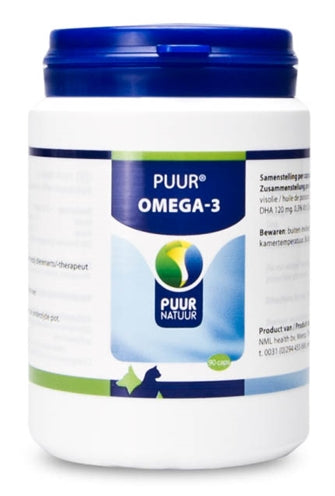
Puur Omega-3 90 caps
For flexible movement. For healthy skin and coat. For the heart. For hypersensitivities. For healthy intestines. For the immune system. For mental health.
- Complementary feed
- Suitable for: Human, Cat, Dog, Rodent, Horse, Pony, Bird
Composition:
- Composition per capsule: fish oil 1000 mg; EPA 180 mg; DHA 120 mg. 0.3% Vit E (d-alpha-tocopherol)
Indication(s):
- For flexible movement
- For healthy skin and coat
- Good for the heart. For hypersensitivities
- For healthy intestines
- For the immune system
- For mental health
- For severe shedding or red skin
As a standard supplement to the diet for maintaining healthy skin and coat condition
Administration: directly into the mouth or mixed with food
Analysis:
- (per capsule) fish oil 1000 mg of which EPA 180 mg and DHA 120 mg. 0.3% Vitamin E (d-alpha-tocopherol)
Properties per ingredient:
Polyunsaturated fatty acids can be divided into two main families: the omega-3 family (alpha-linolenic acid group) and the omega-6 family (linoleic acid group). Because animal bodies cannot produce these fatty acids themselves, omega-3 and omega-6 fatty acids must be obtained through food or supplementation. These essential fatty acids were formerly also called vitamin F.
In the twentieth century, the ratio of omega-3 to omega-6 fatty acids in the diet shifted strongly towards omega-6 fatty acids. The increasing use of vegetable oils and fats, which are rich in omega-6 fatty acids, stimulates the formation of arachidonic acid at the expense of EPA and DHA. Arachidonic acid itself is abundantly present in the Western diet. It is estimated that the ratio of omega-6 to omega-3 fatty acids in the Western diet is approximately 20-25:1. Researchers suggest that a ratio of approximately 5:1 is more desirable. Evolutionarily, dogs (and their predecessors) consumed omega-6 and omega-3 in a ratio of (probably) 1:1 for millions of years.
The enzyme delta-6-desaturase regulates both the conversion of linoleic acid to DGLA and the conversion of ALA to (ultimately) EPA. An excess of linoleic acid means that ALA can hardly use the enzyme, and therefore hardly any EPA and DHA are formed. This enzyme is already the slowest step in the chain, and its activity is also inhibited by many dietary factors (including trans fatty acids; saturated fats; deficiencies in zinc, magnesium and/or vitamin B6; alcohol) and metabolic factors (hypercholesterolemia; diabetes; certain medications). As a result, in our Western society, many animals can hardly form GLA and EPA themselves, and these fatty acids must therefore be supplied through the diet.
Dosage and application:
Unless otherwise prescribed by the doctor or therapist.
The optimal dosage 1 x daily: (Gradually build up the dosage).
- Dog 1 - 3 capsule(s)
- Cat 1 - 2 capsule(s)
Advice for use:
In an acute situation, the dosage may be increased on the advice of a veterinarian. When administering Omega-3 oil, loose stools may occur initially. If necessary, build up gradually.
Treatment duration:
Omega-3 fatty acids are incorporated into cell membranes. This is a process that takes several days to 2 weeks. The effect is usually visible after 1 to 3 weeks. After symptoms decrease, a maintenance dosage can be used. This is usually half of the indicated dosage.
Payment & Security
Related products

Recently viewed




About Fietsenwinkel.be

Fietsenwinkel.be is the online bicycle specialist of Belgium and the Netherlands since 2015. Part of Tormino B.V. (CoC: 84663545). Specialist expertise and competitive prices through bulk purchasing.

